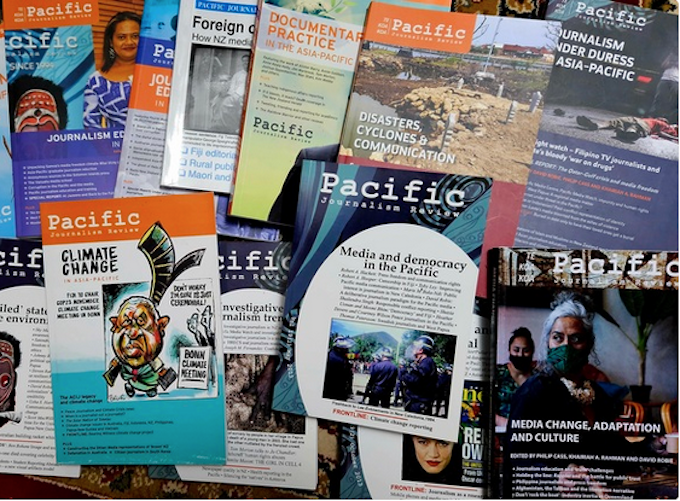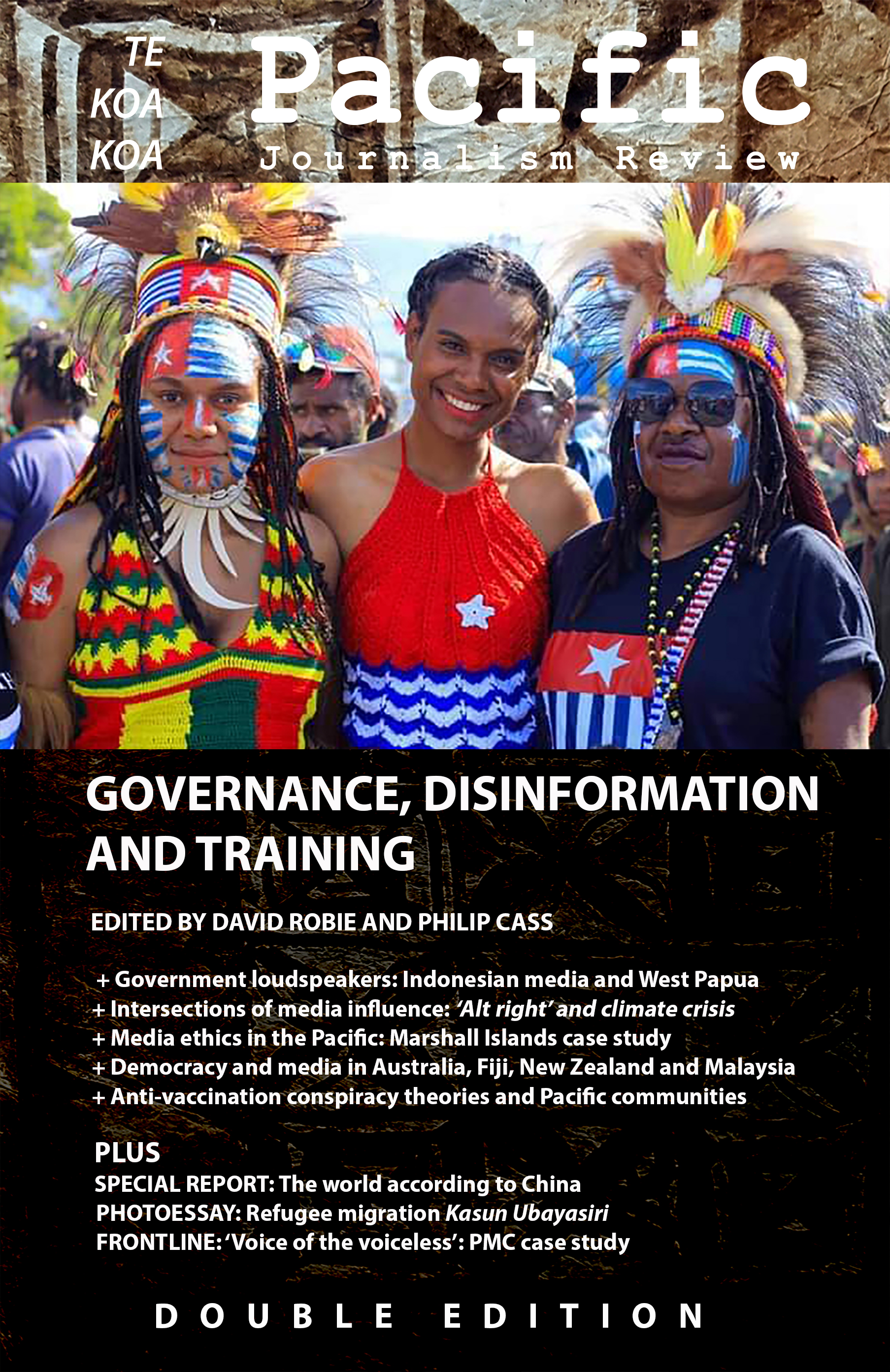
Pacific Journalism Review


Journal re-launch

Dr Tupeni Baba's speech at the relaunch of Pacific Journalism Review, 3 October 2003

Senior Research Fellow, Centre for Pacific Studies, Auckland University and former Deputy Prime Minister in the Mahendra Chaudhry Labour-led Government deposed in an attempted coup in May, 2000.

Thank you for your invitation to be your guest at the re-launching of the Pacific Journalism Review journal. I must acknowledge the presence of the editor of the Listener, Mr Finlay Macdonald,. who is speaking with me today and note that the first time I became aware of his journal was back in 1987, when it devoted a whole issue on the Bavadra Government.

I am not sure whether that particular issue came out while we were still in government, or whether it actually came out after we were pushed out in the coup that followed shortly afterwards on May 14 of that year.

I recall that the only other time I featured in that magazine was last year, 2002, on coming to the University of Auckland and the point of interest I guess for the Listener, was that I was again thrown out of another Government by another coup, or attempted coup, of George Speight and incarcerated in the Fiji Parliament for some 56 days.

There was some implication in the article that I was cooling my heels, so to speak, in the comforts of academia in some kind of exile.

On this occasion, I must acknowledge the role of my former University of the South Pacific colleague, Mr David Robie, as founding editor in the development of this journal.

David worked at the University of Papua New Guinea where the journal was first produced. He shifted to USP where he worked for five years. He was there during Speight's attempted coup of 2000 and encountered some difficulties with the post-coup Interim Government attempts to clamp down on freedom of information.

He came "home" to the School of Communication Studies at AUT last year where the journal is now housed and produced. Journals, like academics, need a supportive environment in terms of resources, and intellectual and professional atmosphere not to mention the students. In addition to the staff of the School of Communication Studies, the journal is fortunate to be able to draw on the members of the Pacific Islands Media Association (PIMA), which, judging by its list of potential membership and those attending the PIMA conference, has some of the top Pacific practitioners in the field.

David Robie asked me to comment on Fiji politics, democracy and the role of the media in political and democratic process. I will try to discharge that responsibility.
I have served in two governments with very progressive agendas: the 1987 Government of Dr Bavadra, and the 1999 Labour-led government of Mahendra Chaudhry. The two governments had very different and contrasting attitudes to the media. Relationship with the media during those times were influenced by the ideology of the dominant party in the government, the personality of the relevant ministers' responsible, and the politics of race that dominated politics in Fiji at that time.

The Bavadra Government came to power with a lot of support from young journalists who identified with the Labour ideology. Many of them were associated with the trade union movement and with the educated urban professionals. During the campaign leading up to the General Elections, the press was very supportive and with a few exceptions, we received a very favourable coverage both in the newspapers and radio.

I recall going down with Dr Bavadra to the Fiji Broadcasting Commission to record his first Address to the Nation to mark the beginning of the election campaign. He spoke as I sat on his side and as he finished, we looked up through the glass partition to see the adjacent room packed with reporters, media people and workers associated with the FBC who had been listening, giving us a "thumbs up". Obviously, Dr Bavadra had struck the "right" chord in his address. We knew with that kind of indicative support, we should win.

Similarly in the 1999 General Elections build up, we received a lot of support but nothing compared to 1987.

After the Rabuka coups in 1987, the members of the media, especially journalists, publishers and broadcasters, were treated harshly by the military, and many stood their ground. Many tales of gallantry and courage have been told about them. Unfortunately, not all of these stories have been documented and published so they could be available to young and trainee journalists.

But as Rabuka raised the bogey on the protection of indigenous Fijian interests as against Indian interests, ethnic issues became dominant and they were exploited. The owners of the major media groups identified with Rabuka as were other important national institutions like that of the Fijian Methodist Church and the Great Council of Chiefs.

As a consequence, journalists and media people who continued to support democracy were branded as anti-Fijian or pro-Indian. A lot of pressure was exerted on journalists and media people and their work relationship was affected and strained. This contributed to the pressure for many of the more senior people to migrate overseas.

The Chaudhry Government of 1999/2000 similarly had good support from the media people. Its policies as reflected in its Election Manifesto were fairly progressive but as the post of Prime Ministership was settled, various tensions became apparent.

Mr Chaudhry as Prime Minister, allocated himself the portfolio of Minister for Information and had one of his close supporters with very little understanding of the media appointed as Assistant Minister, to look after the Information Section.
Mr Chaudhry took a high-handed attitude and a personal dislike and distrust for the media. He criticised them unnecessarily and directed personal attacks on some of its leading members. This set the scene for an unnecessary "media war" between the Government and the media. For weeks and months on end, the Government was vilified and criticised by the media. The Chaudhry-led Government filed the highest number of complaints ever reported to the Fiji Media Council by any government.
This atmosphere of tension and distrust between the Government and the media continued throughout the time that Government was in office.

When the protest marches against the Government began to take place, the media highlighted it and the Government increasingly looked very bad. It played into the hands of the Taukei militants and other opposition groups who wanted to protest against the Government.

When Parliament was stormed and taken over on 19 May 2000, the focus of attention shifted to George Speight. Members of the media were allowed to come into Parliament under the protection of Speight's militants.

They were in fact the first "embedded journalists" in the Pacific and they wrote what they saw, and like "embedded" journalists in the Iraq war, they were to an extent influenced by the perspectives of Speight and his militants.

Similarly, during the Rabuka coups, many overseas journalists who were given access and protection by the military also reported with similar insights from the military's perspective.

In hindsight, the Chaudhry Government was overly concerned with its own survival, and the attitude of the Minister who was also the Prime Minister did not help. This was in direct contrast to the attitude of the Bavadra Government to the media. The Minister at that time, Mr Harish Sharma, was himself Deputy Prime Minister and his policy, which was consistent with the Coalition Election Manifesto, was to allow greater freedom of the press and the media, and the Minister followed this closely.

The Chaudhry Government on the other hand had a greater opportunity to develop a better relationship with the media because of its longer tenure in office compared to the Bavadra government, had it not been for the high-handed attitude of the two Ministers involved. This, in my view, can happen to any Government, irrespective of its ideology.

The tendency to defend existing or entrenched interests and hegemony (Robie, Pacific Journalism Review, 2003) is very evident in Fiji and progressive Governments have an uphill battle to win an opinion campaign. Those who are likely to lose out tend to be more vociferous than those who support change and this is supported by Machiavelli in The Prince:

'There is nothing more difficult to plan, more doubtful to success, more dangerous to manage that the creation of a new system. For the initiator has the enmity of all who would profit by the preservation of the old institutions and merely lukewarm defenders in those who would gain by new ones.'

The composition of the Media Councils in some Pacific countries like the one in Fiji also demonstrates attempts to protect entrenched interests and hegemony and it works against progressive governments who support greater empowerment of the people. In the Fiji Media Council for example, there is a strong representation of the major media industry together with that of the Government. The Government itself, especially when pre-occupied with its survival, is conscious of this, like the Chaudhry government was.

In the case of Fiji, the over representation of the media industry could even work against the right to free speech which is a necessary ingredient of democracy. In a situation of foreign ownership of major media outlets, this can lead to protection of the interest of foreign capital. As pointed out by Richard Naidu (2003), this takes the form of putting emphasis on privacy laws and breaches rather than on the need to defend the freedom of information as in the case of Fiji. The Qarase Government is keen to push through a media legislation, which further strengthens existing provisions aimed at "'muzzling the media" so to say instead of promoting Freedom of Information legislation. It shows again the action of a government "under siege mentality".

It seems that there is a need for some protection even against well-established media industry in developing countries like the Pacific and one way to do this is through the encouragement of independent journalist/media personal representation in Media Councils.

For these independent journalists, according to Richard Naidu, their very survival depends on the freedom of information. This freedom can be stifled by self-censorship if the emphasis is centred on privacy laws and breaches, as is the case in Fiji. Futa Helu of Tonga (in Robie 2003) has reminded us that, we need to be aware of the "distinct ideology" of the media itself if we are to understand its operation.

By its very nature, it is concerned with democratic values which are integral part of liberal democracies, and Pacific countries advocating for democratic institutions which includes press and information freedom should concentrate their efforts on enhancing the capability of the people to make their "right" choices rather than make the assumption that they cannot make such choices and accordingly, make choices for them.

What works to the disadvantage of Pacific media is the very limited number of independent journalists who could exert such influence as mentioned by Naidu. Some of our top journalists are already abroad in New Zealand and Australia but hopefully they will return after some Freedom of Information Laws are put in place and Media Council legislation is revised. In the absence of a local core of independent journalists, media laws will continue to protect the interests of the privileged and the powerful who will continue to work in the interest of foreign capital and multinational media corporations.

These forces will combine to undermine capacity building and the development of strong, vibrant and independent local media.

These, in my view, are some of the issues which professionals in the Pacific Islands Media Association and media educators in universities such as Auckland University of Technology (AUT) are in a position to address. With these few words, I am very happy to be associated with the relaunching of Pacific Journalism Review.

Dr Tupeni L Baba
Senior Research fellow
Centre for Pacific Studies
The University of Auckland.
October 3, 2003.
t.baba@auckland.ac.nz

Pictured above: Finlay Macdonald (from left), Dr Baba and David Robie at the launching.