Back Issues
Abstracts of Vol 9, September 2003
Theme
IRAQ AND THE MEDIA WAR: pp 8-43
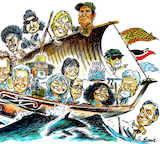
Abstract: Two months after ‘liberating’ Iraq, the Anglo-American authorities in Baghdad decided to control the new and free Iraqi press. Newspapers that publish ‘wild stories’, material deemed provocative or capable of inciting ethnic violence, are being threatened or shut down. A controlled press is a ‘responsible press — just what Saddam Hussein used to say about the press his deposed regime produced. In this edition of Pacific Journalism Review, essays by media commentators present several perspectives on the war and its aftermath. Patrick Ensor gives an overview, Louise Matthews provides media context for the war, John Pilger challenges journalists, Mohamed Al-Bendary profiles the pan-Arab satellite boom, and Alastair Thompson and Russell Brown examine the New Zealand media connection. Cartoonists Steve Bell (The Guardian) and Deven (Le Mauricien) add their views. Critical of the ‘embedded’ media, Bell laments: ‘There’s never been a more dangerous time to be a journalist at war.’
- Iraq, the Pentagon and the battle for Arab hearts and minds pp 8-13, Patrick Ensor
- The ‘liberation’ truth is unmentionable in America pp 14-18, John Pilger
- Drawing fire without a cartoonist’s
flak jacket pp 19-2, Steve Bell - The latest casualty: Phillip Knightley and media failure pp 22-25, Louise Matthews
- Watching the war against Iraq through pan-Arab satellite TV pp 26-31, Mohamed El-Bendary
- CNN war porn, 'shock and awe' and a set designed in Hollywood pp 32-38, Alastair Thompson
- Humming ‘Que Sera Sera’, Russell Brown pp 39-43
Articles
The construction of a national Maori identity
by Maori media pp 45-58
Ian Stuart
Abstract: This article discusses the Maori construction of a national Maori identity by the Maori media, and by Maori radio in particular. It then suggests that this is creating a Maori nation within the state of New Zealand. This is an important development for Maori and for the future of New Zealand society. The article suggests that Maori are creating a fully developed identity as required by the radical democratic theories of Ernesto Laclau and Chantal Mouffe, and, as such, will provide a practical case study of their theories.
Coverage of international and Pacific news in
The Fiji Times and The Australian pp 59-78
Folker Hanusch
Abstract: The debate over the nature and flow of international news has dominated intellectual debate about journalism practice for some time. Developing countries argued there was an imbalance in the nature and amount of international news concerning them. They argued that the Western media rarely reported on developing countries and when they did, reported predominantly negative news about developing countries. The debate led to calls for a New World Information and Communication Order (NWICO). A number of studies examined its arguments, many finding developing countries were indeed disadvantaged by the Western media. This study compared foreign news coverage in The Australian and The Fiji Times, with special attention on news from the Pacific Islands region. It found the coverage of the Pacific Islands was still grossly inadequate in both newspapers. The coverage consisted of only a small number of stories, which were predominantly negative, surprising especially in the case of The Fiji Times.
Your Asia-Pacific Network: The use of
Radio Australia by the Australian Government pp 80-101
Andrew M. Clark
Abstract: This article examines the use of Radio Australia by the Australian Government. It examines the extent that the Australian Government’s foreign policy goals are reflected in the charter and programming of Radio Australia. The paper begins with a brief historical look at Radio Australia followed by description and analysis of the role of government control in Radio Australia’s operation; the role of an intermediary between the government and the station, which, in this case, is the Australian Broadcasting Corporation (ABC), the parent company of Radio Australia; the programme philosophy of, and programming offered by Radio Australia, and criticisms of Radio Australia from within the Pacific.
Pacific media councils and cultural values:
Safety valve or entrenched hegemony? pp 102-122
David Robie
Abstract: Two countries in the South Pacific, Fiji and Papua New Guinea, have adopted contrasting media council models to self-regulate the media amid growing political and cultural pressures on the news industry. Projected as promoting media standards and professionalism and a model for the region, the realities have raised questions about whether such bodies are self-regulatory mechanisms genuinely working in the public interest in the Pacific or defending entrenched media and power relationships, some foreign, from pressure by island governments. There are also questions over whether codes of ethics promoted by the councils are effective as self-regulatory tools for the media. Exploring case studies such as media coverage of the controversial John Scott double murder case in Fiji, the Speight attempted coup and political crises in Papua New Guinea, this article examines these dilemmas and also whether codes of practice reflect regional ‘Pacific way’ cultural values, or are in fact adopted as part of globalisation.
Teaching press freedom and open justice: A model
for debate pp 124-137
Mark Pearson
Abstract: This article explores ways of building the topics of press freedom and open justice into the tertiary journalism curriculum. It uses reflective practice techniques in developing a series of two by three hour workshop modules centred around introducing students to the principles of press freedom and open justice, exploring cases where these issues have been tested in the courts, and building students’ skills in defending press freedom and open justice in the newsroom and the courtroom. It uses problem-based and experiential pedagogies to bring historical and philosophical principles to life and make them relevant to students’ experiences and current newsroom practices. Finally, it invites comments and discussions on other curricular and pedagogical approaches to teaching these topics.
Press Coverage of HIV/AIDS in the South Pacific:
Short-term view of a long-time problem pp 138-147
Trevor Cullen
Abstract: In 1999, the author conducted face-to-face interviews with 25 newspaper editors from several South Pacific countries. The findings highlighted a worrying sense of complacency and lack of knowledge about HIV/AIDS among the editors. Moreover, most of them were not convinced about the potential disastrous affect an HIV/AIDS epidemic would have on the political, social, economic and social landscape of their respective Pacific countries. The lack of editorials and front-page stories reinforced this view. New stories focused mainly on statistics and workshops. There was little mobilising information or human-interest angles which might have motivated self-protective behaviours or changed socio-political educational approaches. However, three years later. In September 2002, the author returned to the largest country in the Pacific, Papua New Guinea, and recorded a significant shift in attitude among the editors. What led to this ‘change of heart’ and will it result in a different approach to reporting HIV/AIDS?
Commentaries
Integrating student-centred learning in Asia-Pacific pp 149-155
Sharon Tickle
Abstract: Universities are ideally placed to support the developing media industry in the Asia-Pacific by integrating their student projects with community service activities. Particular opportunities exist to support the mission of media industry support organisations by using the worldwide web as a platform for information dissemination, training and campaigning. The benefits for the media partner, the academy and the students are considerable. This article presents a successful model in East Timor and Melanesia that may be adapted in other tertiary institutions